Friday, June 17, 2016

Wolf Hollow

Wolf Hollow
Lauren Wolk
Dutton, 2016  291 pgs.
Grades 4-7
Historical Fiction

Eleven-year-old Annabelle is growing up on her family's farm in rural Pennsylvania during World War II. Her predictable life gets shaken up when a new girl named Betty enters her one-room schoolhouse. Betty is a bully of the worst sort and a liar to boot. She threatens Annabelle using her brothers as bait in exchange for money. Annabelle is undecided as to how to handle the situation, which escalates as her best friend looses an eye at the hand of a carefully aimed rock, thrown by Betty. Betty twists the situation around, blaming a mentally damaged WWI veteran, Toby, who squats in the family's abandoned smokehouse. When Betty disappears, folks from the community point fingers at Toby. Annabelle knows that he is innocent and that Betty was most likely hurt while causing trouble. She cleans Toby up, dresses him in Grandpa's castoff clothes, and hides him in the barn. Her plan next involves Toby joining the rescue efforts. Annabelle has a sudden revelation of where Betty is and sends Toby and the rest of the rescuers to save the day. Betty is found and retrieved by Toby from the bottom of an abandoned well and both Toby (who introduces himself by his last name) and Annabelle are heroes. Despite being rescued and under doctor's care, the worst possible outcome finds Betty and the small community becomes passionate about capturing Toby and punishing him for what they think are his misdeeds. Annabelle concocts a new plot to get Betty's friend to reveal Toby's innocence, but is she too late to save him?


To Kill a Mockingbird meets The Walton's in this step back into America's rural past. Wolk bases this tale on the childhood stories of her mother and the authenticity comes through in her writing. The reader truly experiences what farm life was like during this pivotal time in our history. Wolk nails Annabelle's voice and allows her to be a realistically flawed hero that kids will both emulate and relate to. Even though the main character is a girl, boys will enjoy this story and the beautifully designed cover is neutral, inviting both sexes to the party. Annabelle does not have an easy life. Unlike today's children she is expected to do serious chores and contribute to the family. She lives before televisions were introduced into the homes of Americans and communicates on a phone with a party line and a nosy operator. Through it all, she has a loving family and a happy life. Facing adversity and moral dilemmas once Betty moves to town, Annabelle rises to the occasion and follows her moral compass, even when doing the right thing is the tough choice. Many ethical themes are brought to light in this novel including the importance of honesty, the painful motivation of bullies, PTSD and the plight of the veteran, family unity, loyalty, and making the right choices, even when it is hard. The story is craftily told, offering a swiftly moving plot and twists and turns along the way. It will be useful for teachers, as well as enjoyed recreationally. Give to fans of The War that Saved My Life and Jennifer Holm.

Thursday, June 16, 2016

Dragon Masters: Rise of the Earth Dragon

Dragon Masters: Rise of the Earth Dragon
Tracey West
Graham Howells, Illustrator
Scholastic, 2014  90 pgs.
Grades 2-4
Fantasy
Dragon Masters Series vol. 1


Young Drake is pulled off his family's onion farm by soldiers and taken to serve the king. Once at the castle a wizard named Griffith greets him with a big surprise: Dragons really do exist and Drake, along with three other children, have been chosen to train a dragon for the King's service. The other young people are already ensconced at the castle and introduce their respective dragons, who are all much flashier than the mud color dragon assigned to Drake. He names his charge Worm, a fitting name for this Earth Dragon's personality and appearance, and the two instantly bond. Drake can feel his necklace, given to him by Griffith start to glow when he's around Worm and he gets mysterious telepathic flashes of his new friend's life before capture. When the four young Dragon Masters attempt to leave the castle one night for an adventure, danger strikes in the form of a red orb, which causes the dragons to go mad and the tunnel they are currently escaping from collapse. Drake and Worm use their newly found telepathic powers to help the gang escape, proving that this non-assuming Earth Dragon has more to him than meets the eye. Griffith's reaction to the ominous red orb leaves the readers with a hint of more adventures to come, leading readers to the next installment of the series, which at present contains five volumes.

Scholastic established the Branches line of books in 2013 in order to bridge the gap between early readers and chapter books. The sixteen series in the Branches line all contain short chapters, controlled vocabulary, pictures on every page, linear story lines, and are less than one hundred pages. Best of all they have plot lines and humor that appeal to the intended audience and are attractively designed.  This particular series is perfect for children not quite ready for the Magic Tree House, but drawn to fantasy. It will appeal to boys, but will be enjoyed by girls as well. Drake is an unlikely hero that kids will relate to. The reader will immediately connect with him and root for his and Worm's success. Dragons are cool, as are wizards, and kids will want to read this book. The black and white illustrations are excellent, add the story line, and are on every page as promised. A great choice for parents looking to ease their kids into chapter books, older children struggling with reading who need to build confidence, or for grown-ups looking for a short and fun chapter book to read aloud to younger children. This is a series that works to grow readers and although they aren't the most sophisticated books on the planet, they do the intended job very nicely.

Wednesday, June 15, 2016

The Tale of Despereaux

The Tale of Despereaux
Kate DiCamillo
Scholastic, 2003 270 pgs.
Grades 3-6
Fantasy/Fairy Tale

Despereaux is a tiny mouse with a big problem.He is drawn to stories and music and finds himself in love with a human princess named Pea. Worst of all he doesn't behave like other mice are expected to and somehow missed the gene to scurry. Because of his attachment to the princess, Despereaux is sent to the bowels of the dungeon, from which mice do not return. Now we meet our anti-hero, a rat named Roscuro, who finds himself unnaturally drawn to the light. An unlucky series of events leads Roscuro above ground to the living quarters of the family, resulting in the demise of the queen and the outlawing of soup, which is a hardship to the entire kingdom. Next we follow the adventures of peasant Miggery Sow, who was sold by her father into servant-hood, treated shabbily, and finds herself working at the castle as a serving girl to the Princess Pea. Mig wants to be a princess and allows herself to get drawn into a dastardly plan to kidnap the princess by Roscuro, who wants royal revenge. All of our characters come together in a climatic crescendo, where Despereaux proves that even small creatures can save the day. Old hurts are healed, old wrongs righted, and our heroes are restored to their rightful place in the universe, more or less, in a satisfactory ending.

Brilliant author and last year's National Ambassador for Young People's Literature, Kate DiCamillo won her first of two Newbery medals for this title and rightly so. The story appears to be simple, yet contains layers that merge at the end, resulting in a sophisticated and satisfying read. It is hard to find non-series fiction of a high quality for younger readers. Despereaux fills the bill, making this title a favorite for teachers and librarians alike. I have re-read this title to prepare for my end-of-the-year book discussion extravaganza for both of my book clubs, where we will read the book, watch the movie and then compare the two, while eating ice cream. Soup would be more fitting, but I would have a book club mutiny, so am sticking with ice cream. The Tale of Despereaux reads like a classic fairy tale, complete with a princess, yet is not girlie. It is filled with adventure and unlikely situations that are written by DiCamillo's capable hand to appear likely. The generous illustrations invite reluctant readers to the party and the wide margins and short chapters help the intended audience to turn pages quickly. DiCamillo offers not just a great story, but food for thought as well. She sprinkles difficult vocabulary throughout the book, encouraging readers to look certain words up, such as "perfidy". Themes explored are the power of light, forgiveness, storytelling, and, of course, soup. One of my all-time favorite book selections for young people, it is sure to be enjoyed by a wide audience. This book is a solid choice for all young readers and continues to be a modern children's classic.

Tuesday, June 7, 2016

Simon vs. the Homo Sapien's Agenda

Simon vs. the Homo Sapien's Agenda
Becky Albertalli
Balzer + Bray, 2015  320 pgs.
Grades 9-Up
Realistic Fiction

Our story starts with blackmail. Simon accidentally leaves a computer logged into his e-mail where a friend-emy named Martin reads it. Simon is secretly gay and is conducting an on-line friendship with someone named "Blue", who's identity in unknown, but is a fellow student at Simon's school. Simon is not ready to reveal his sexual orientation or expose his developing relationship with Blue to the general public. What Martin wants in exchange for his discretion is to get to know Simon's friend Abby better. Meanwhile, Abby is interested in Simon's guitar playing best friend Nick, as is Simon's other best friend Leah. Sound confusing? Its all part of high school life as Simon and his friends work out their romantic relationships and friendships all under the backdrop of the high school musical. Simon is not the only one with secrets. Both friends and family reveal private parts of their own lives and Simon realizes that life's not just all about him; a valuable lesson for all teenagers. Eventually Simon is "outed" and not on his own terms. After an initial bullying attempt by some homophobic school jocks, the dust settles and Simon is excepted for who is truly is. The identity of Blue is satisfactorily revealed and Simon's story ends with a happily-ever-after, sure to please most teens.

Albertalli offers a light and breezy romance featuring believable, funny, likable, and flawed main characters. The whole cast is well developed and interesting and diverse enough for most teens to find someone to relate to. Simon, out star, is highly likable and will have readers cheering for him and hoping that Blue, the boy he has fallen in love with on-line, is a real person. I was nervous that this plot thread would turn ugly, but Albertalli gives Simon a happy, if a bit unrealistic, ending. Blue, who is extremely private and careful, does a 360. He turns out to be a real person (a character we already sort of know) and becomes Simon's boyfriend publicly and without inhibitions. I don't know that real life runs quite so smoothly, but I can't help but be happy for Simon and will chose to let go of my adult cynicism. I love that Simon is part of a flawed, yet functional family and both his sisters and his parents play staring roles in the story and matter to him. Alberalli infuses a lot of humor into the story, making some awkward and difficult moments less intense. The book reads quickly and is hard to put down. The mysterious identity of Blue will help readers to turn pages and then, once he is revealed, to find out what will happen with the romance. There are a lot of players in this drama, but Albertalli writes everyone so distinctly that they are not hard to tell apart. A fun book covering some serious topics, it is a worth while read for teens of all gender identities and sexual orientations.

Monday, June 6, 2016

It Ain't so Awful, Falafel

It Ain't so Awful, Falafel
Firoozeh Dumas
Clarion Books, 2016
Grades 5-7
Historical Fiction

Dumas turns from writing the Iranian-American experience for adults to capturing it for the middle grades. Based on her real-life experiences, Dumas traces three years in the life of Zomorod (re-branded as Cindy), as she moves to a new community in California during the Iranian Hostage Crisis of the 1970s. Cindy struggles to fit in. After a massive fail at friendship with her horse-loving next door neighbor (also named Cindy), she falls in with a group of smart girls at her new school who become true friends. The girls participate in Girl Scouts together, which is a positive experience for Cindy, whose family is struggling with life in America. Mom knows no English and is depressed from missing her family, not fitting in and feeling lonely. Dad loses his job after the revolution in Iran and a group of Americans are held hostage for no apparent reason. Dad, an engineer, sends out resumes daily, yet cannot even be granted an interview. The prejudice against Cindy's family deepens as hate letters are left on her doorstep, as well as garbage and, even more disturbing, a dead hamster. Cindy's new friends help her to overcome the hatred and feel accepted. After the job hunt seems like a hopeless case and their money is running out Cindy's parents decide to move back to Iran even though there are no longer any rights or freedoms for women in their home country and no guarantee of their personal safety. It takes the condo community in which they live to ban together and help out Cindy's family, allowing them to stay in the United States and at last to feel at home in their new country.

This is the second book in a row I've read this week in which events I have lived through have become historical fiction. Cindy's adolescence mirrors my own from wearing gauchos and using Bonnie Bell Lip-smackers to awkwardness around boys and being underpaid for babysitting. Our experience differs in that I was not Iranian during the American Hostage Crisis and although I remember my family tracking the details, it wasn't as personal for me. Cindy shares the experience of being bi-cultural with many American youngsters and her feelings of not fully belonging in either world will transcend to many readers. Prejudice against Muslim Americans is still very predominate today and, especially with so many Syrian refuge children integrating into many American schools, Cindy's story is extremely relevant. The books covers some serious issues, yet at its heart is also a story about growing up and friendship. Dumas interjects humor throughout the story (my favorite part being the depiction of the horrible visiting cousins from Iran), which keeps the book from becoming too weighted. The chapters are short and the book reads quickly. It moves along nicely and never lags or gets boring. Dumas reveals the truth behind the fiction in an author's note and the story is that much more powerful knowing that much of it is real. An enjoyable and important read for young people, it shows the importance of diversity, the ugliness and unfairness of prejudice, and the power of community.

Sunday, June 5, 2016

Nine, Ten: A September 11 Story

Nine, Ten: A September 11 Story
Nora Raleigh Baskin
Atheneum, 2016  193 pgs.
Grades 4-7
Historical Fiction

Baskin traces the 48 hours leading up to and including the events of September 11, 2001 as seen through the eyes of four young people. They start the story together with overlapping experiences, yet not interacting, at an O'Hare Airport in Chicago and then they are scattered in different directions to tell their tales. Sergio is a smart, yet economically deprived young man with his grandmother in Brooklyn. While skipping school on September 10, he is befriended by a NYC firefighter, establishing a connection that makes the bombing of the twin towers personal. Will, grieving the loss of his father a year earlier and experiencing his first crush, watches first hand as the airplane crashes in his hometown of Shanksville, PA. Amy starts at a new school in California, where she feels like an outcast. She really needs her mother to talk to, but Mom is in New York City on business, heading for a meeting the World Trade Center. Finally, Nadira is also starting at a new school. She has begun to wear a hijab, an important symbol of her Muslim faith. After the terrorist attacks are revealed to the student body at her school she feels exposed and frightened for her personal safety. The end of the story takes place one year later. All four young people have traveled to New York for the Memorial Service, where they once again share a space and an encounter, yet still remain separate.

This felt so weird determining that a book about September 11 is historical fiction, but to today's youth, the target audience not being alive when the described events happened, it is indeed historical fiction. I went recently to the National September 11 Memorial & Museum in New York, basically because my visiting father wanted to go. I was pregnant with my daughter during this horrible chapter in American history and haven't really talked about it much with either of my children. The events are too painful and personal and I haven't wanted to revisit it. My thirteen year old daughter was moved at the museum and asked questions, which got me talking, crying, and healing. Kids are starting to learn about the events of September 11 in school and fictionalized stories are a way to present the information in a personal and relatable way. Baskin gives an accurate and well researched account of the experiences of the four very different young people. She shows the fear and shock they are feeling and does not shy away from the brutality of the events. She intentionally, as explained in an author's note, does not have any of the four young people lose anyone close to them. The story is disturbing enough for the intended audience without bringing more tragedy to the proceedings. The prejudice against American Muslims at the time (and still happening today) is an important chapter to the story and will hopefully give today's readers a useful "take away". Honest and accurate without causing nightmares, Baskin hits the nail on the head for today's young people who would like to know more about this horrible tragedy and may spark meaningful conversations with parents and other grown-ups who lived through it.

Friday, June 3, 2016

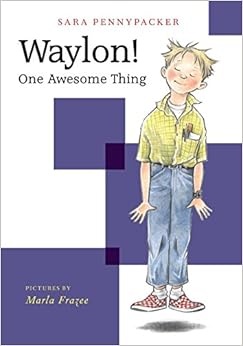
Waylon! One Awesome Thing

Waylon! One Awesome Thing
Pennypacker, Sara
Marla Frazee, Illustrator
Hyperion, 2016  198 pgs.
Grades 2-5
Realistic Fiction

Everything is different in fourth grade for science-geek Waylon. At school the boys has split into teams, determined by class kingpin, Arlo, which makes life awkward for Waylon who wants to be friends with everyone. At home his older sister has changed into a moody and angry teenager and the transformation has shifted the entire family dynamic. Waylon weathers the storm by purchasing a science journal and scribbling his musings about the natural and scientific world. Equilibrium is shaken once again when a former student and alleged juvenile delinquent re-enters the class. Everyone is sure that Baxter spent the last few months in jail and Arlo is reluctant to put him on a team. After yet another weird outburst in class Waylon also finds himself team-less. The two outcasts become reluctant friends and Waylon learns the truth behind the personality and intentions of the class "bad-boy". The new team of two bans together to rescue a lovable dog from certain death and the rest of the class gets drawn into the adventure. The entire group forms an informal team to rescue the desperate canine and the class goes back to being one big crew of friends with Baxter now part of the group.

Waylon is to Clementine what Stink is to Judy Moody: a companion series to the original featuring a male character to appeal to a wider audience. Clementine is a student in Waylon's class and makes appearances, which will please her fans. Waylon is not only funny and relatable, he will appeal to science-minded kids everywhere. His brain never stops working. Waylon spends a lot of time thinking about gravity (who doesn't?) and he thinks he may have figured out teleportation and is working on time travel. Waylon doesn't want to be a superhero like most boys; he aims to be a science-hero. Like most scientists, his brain doesn't always process social cues and he struggles to figure out people and relationships. The One Awesome Thing (OAT) of the title indicates a game he plays with his family where they share an awesome fact from their day. This game helps him to connect with his sister who is pulling away, but by book's end we understand her better and she softens up, showing the reader that crazy teen siblings will return to sanity. Waylon's family is supportive, quirky, and ever-present, making a nice change from the abundance of independent orphans running around in children's literature. Walyon, himself, is simple and sweet and he pulls his class back together by befriending the outcast, which is a lesson every child should learn. All plots are resolved, yet a last page development will lead the reader to the next installment in the series. The reading level is perfect for the intended audience. The margins and print are big, helping developing readers along. As with the Clementine series, beautifully rendered pencil illustrations are offered by Marla Frazee (one of my fav illustrators), which truly add to the story and break up the text.