Tuesday, May 30, 2017

The Borrowers

Image result for borrowersThe Borrowers
Mary Norton
HBJ, 1953  200 pages
Grades 3-6
Fantasy/Classic

A story within a story, within a story. Kate is stuck sewing with her elderly relation Mrs. May. To pass the time Mrs. May tells the story of her deceased brother's experience meeting "Borowers" when he was a nine-year old boy (we never know his real name) sent to recover from an illness to an old estate in the English countryside. Borrowers are little people who live in the secret places of houses and take what they need to live from the larger humans occupying the premises. The boy meets the borrower daughter named Arrietty and she explains what life is like for herself and her parents Pod and Homily, as well as borrower history with the many families who lived in the house in its heyday, who have since emigrated. Against Arrietty's parent's better judgement, she and the boy become friends. He eventually wins Pod and Homily over when he borrows for them many coveted items, including real furniture from a tucked-away dollhouse. It is when the boy is making a delivery through an open floorboard that the worst happens: the crabby housekeeper catches him at it, spots the little family and goes into a tizzy, calling in the local authorities, an exterminator, and bringing in a cat. There is nothing left than for the family to emigrate, searching for family members who have left before them. Mrs. May's story ends with her own investigation a year later at the estate, which both legitimizes her brother's fantastic tale and plants a seed of doubt at the same time.

I have read this book perhaps more than any other children's book in my life. It was one of my childhood favorites. The thought of little people living in a cozy little space appealed to me and sent my imagination soaring. It is now one of my favorite book club books and I use it on a regular rotation. Being in my humble opinion a children's literature classic that has stood the test of time, The Borrowers is a well written and richly told classic story featuring a well-conceived originally magical creature in the tradition of elves and brownies. As opposed to other such classics, it is a comfortable reading level and is not overwhelmingly long. There are even some pen and ink illustrations to break up the text, of which I poured over the details as a child. It is also a great book for comparing to the movie. The original version came out twenty years ago staring John Goodman and not sticking to the original story at all, which makes for interesting discussion. More recently Ghibli studios released The Secret Life of Arrietti, which follows more closely the story penned by Norton and is beautifully constructed. I love the secret little world where it feels conceivable that these little creatures exist. I love that the main character never gets a name. I love that the ending is left a bit open ended, allowing for the reader to draw their own conclusions about the existence of borrowers, always inciting an interesting discussion in book groups. Most of all I love knowing what happens to the nail clippers and safety pins that I can never find. Mystery solved. Thank you Mary Norton!

Friday, May 26, 2017

Jasmine Toguchi: Mochi Queen

Image result for Jasmine ToguchiJasmine Toguchi: Mochi Queen
Debbi Michiko Florence
FSG, July, 2017 107 pages
Grades 2-5
Realistic Fiction
Jasmine Toguchi series #1

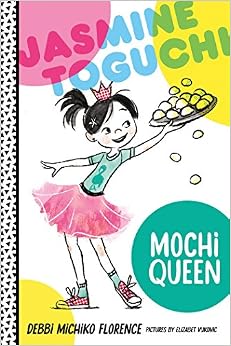
Jasmine Toguchi is excited for the New Year's holiday. Her grandmother, Obaachan, is visiting from Japan and all the members of her extended family will gather at her California home to make the traditional mochi, a special rice treat. Mochi is always made by the men pounding the rice in the backyard, which is rolled into balls by the women in the kitchen. Jasmine is too young to help and is delegated to babysitting her little cousins. To make matters worse, it is her big know-it-all sister's first year helping in the kitchen and her obnoxious boy cousin's second year pounding. To solve the problem of feeling left out Jasmine retreats to her "thinking spot" within the limbs of an elderly neighbor's tree. Here she develops a dandy of an idea. Jasmine decides that instead of trying to copy her sister in the kitchen, she will go her own way and ask to pound the rice. But is she strong enough to lift the hammer? After many failed attempts to build up strength and get her hands on the mochi hammer the day before New Years arrives. Jasmine finally confesses to her father her desire to pound. Will he go for the idea? And will the other relatives, especially traditional Obaachan, back her up? If she gets her way, will she even be able to lift that heavy hammer? All is revealed by book's end and, after a brief misunderstanding, peace and love is restored, the sisters have reconciled, and a happy new year is had by all.

Welcome newcomer, Jasmine Toguchi, whose irrepressible charm and chutzpah will delight the female chapter book set, landing her shelf space besides Junie B, Judy Moody, Clementine, Ivy and Bean, and others. Jasmine offers an added multi-cultural and diverse dimension, exposing readers to Japanese-American culture. Although the fact that Jasmine is Japanese-American is not the point of the story, her ethnicity adds an extra layer to the narrative, setting her apart from other heroines in a crowded genre. Readers will relate to Jasmine's problems of being over shadowed by an older sister, trying hard, but not quite accomplishing a task, and wanting to do something you are not old enough to do. Jasmine problem solves and I love that her thinking place to do so is in the branches of a tree. I also love that her friend is an elderly neighbor. Throughout the book Florence celebrates relations between generations. Also celebrated is the importance of family and traditions, although acknowledging that sometimes these traditions can be "tweaked" to fit a situation. Jasmine's family is kind and supportive and even the older sister and evil cousin show that they care about our feisty heroine. The reading level of this series is on target for the intended audience. The margins are wide, the chapters are short, and the print is big. Attractive illustrations, contributed by Elizabet Vukovic, will entertain the reader, allow for the book to be more approachable, and help to advance the plot. Back matter includes an author's note about mochi, a recipe for this traditional dish, and a chapter insert of the next book in the series, Jasmine Toguchi: Super Sleuth, released simultaneously.

Thursday, May 25, 2017

Pip Bartlett's Guide to Magical Creatures

Image result for pip bartlett's guidePip Bartlett's Guide to Magical Creatures
Jackson Pearce and Maggie Steifvater
Scholastic, 2015  184 pages
Grades 3-7
Fantasy
Pip Bartlett series book 1

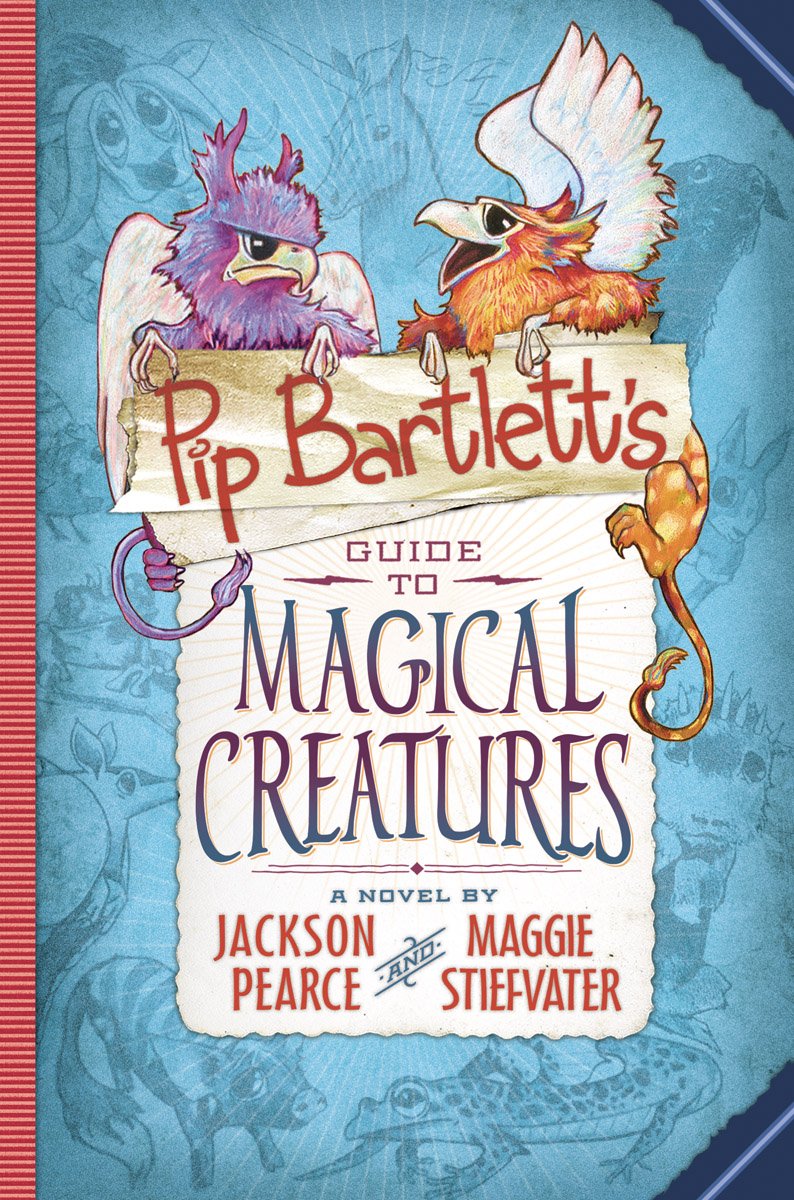
Meet Pip Bartlett, who has an amazing ability: she can speak to magical creatures. Only no one believes her and so far it has only landed her into trouble. When Pip starts a unicorn riot, which demolishes her school's career day, her parents decide to take drastic measures. Pip is sent to spend the summer with her aunt, a magical creature's veterinarian, and Broadway-bound cousin. It is here that Pip encounters her aunt's nemesis, Mrs. Dreadbatch, who is against all magical creatures and is trying to shut down Aunt Emma's facility. Friendship comes in the form of neighbor boy Tomas, who despite his allergy to practically everything, becomes Pip's partner in crime. Pip happily updates her volume of Jeffrey Higgleston’s Guide to Magical Creatures with new information as she conducts her research, until a new  creature threatens to wreck havoc on Aunt Emma's small town. Little harmless-appearing fuzzles start showing up around town in barns and underwear drawers. The problem with fuzzles is that they catch on fire when scared, which can quickly spread. Mrs. Dreadbatch is on the warpath to exterminate the fuzzles and the Higgleston Guide is no help. It is up to Pip to determine what has brought the fuzzles to town and why they won't leave in order to save them from extermination. She must depend on her new friends and family, her ability to communicate with magical animals, and determination and grit to save the little creatures from harm and defeat the intolerable Mrs. Dreadbatch.

Designed to look like a real guide to magical creatures, this eye-catching book will appeal to readers. A collaboration of two seasoned authors for young people, Pearce and Steifvater, know how to draw-in their target audience. Filled with madcap situations, humor, and fabulous beasts, this series opener will keep readers delightfully turning pages. The setting is contemporary suburban United States, yet with a slight twist: magical creatures do exist. Putting this premise in a completely relate-able situation will help kids to identify with Pip and completely give themselves over to the fantasy. The authors have utilized some creatures already part of the folklore cannon, such as unicorns, and have developed some of their own, such as fuzzles. Mrs. Dreadbatch is a perfect foil of the Scooby-Doo variety that all kids will love to hate. Readers will cheer as Pip out-smarts her and saves the day, as well as the clinic. The chapters have snappy headings, the print is a good size, and interesting design elements will draw in reluctant readers. The illustrations all appear to be labeled drawings from the actual guide and are relevant to both the format and the plot and add further interest. The book is cleverly written and is laugh-out-loud funny in certain parts. All readers will enjoy this book, from die-hard fantasy fans to children new to the genre. The series will appeal to readers of the How to Train Your Dragon series. As someone who likes to believe that unicorns are real and maybe exist on some isolated island somewhere, I loved this book and think that children will too.

Wednesday, May 24, 2017

The Epic Fail of Arturo Zamora

Image result for epic fail arturo
The Epic Fail of Arturo Zamora
Pablo Cartaya
Viking, 2017 239 pages
Grades 5-8
Realistic Fiction


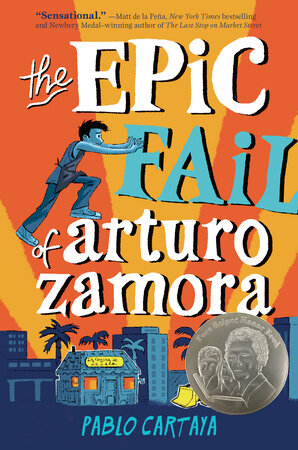
Meet Miami native, Arturo Zamora. He helps his extended family run the family business: a neighborhood restaurant featuring the delicious Cuban food that his beloved Abuela became locally famous for cooking. Now Abuela is old, Arturo's mother has taken over chef duties and Arturo is delegated to a job washing dishes for the summer. Even though his two best friends are away during the school break, his life brightens when family-friend Carmen moves to their neighborhood with her father after the loss of her mother. Arturo and Carmen make an instant connection and he finds himself experiencing his first crush and getting all tongue-tied around his former playmate. Carmen loves poetry and Abuela shares her late husband's writings and love of poetry with Arturo as inspiration to connect to Carmen. Meanwhile, an oily developer takes the neighborhood by storm. He wants to build a giant high-rise building with many amenities, gentrifying the neighborhood, and pushing the family restaurant out. The neighbors seem thrilled with the projected project and Arturo's family is faced with fighting a battle for their livelihood, as well as for the preservation of the soul of the neighborhood. Then tragedy strikes as Abuela's health begins to deteriorate. Arturo has to discover life’s true priorities and to fight for them, finding inner courage and personal strength along the way.

I enjoyed this book a lot, penned by a relatively new author, Pablo Cartaya. The Miami setting is unusual in juvenile books and is fully realized and integral to the story. At its core this is a book featuring a boy who must find his inner courage to help his family and do the right thing in a classic battle of good verses evil. The developer is clearly the villain and is presented almost as a caricature, yet kids will feel comforted in the clear-cut lines of who the good guys are. Other themes besides the pitfalls of urban development and the importance of family include loyalty, standing up for what is right, overcoming grief, and the magic of finding one's soulmate. The "Epic Fail", as hinted at in the title, refers to Arturo's confession of love to Carmen, of which she initially seems to reject. He gets the girl in the end, which results in some innocent kissing. This is a story that is aimed mostly at boys, but girls will enjoy it as well. Because of all of the character building within the novel, it would be a great fit in the classroom. The Epic Fail also offers readers a glimpse into Cuban-American culture, which adds an extra dimension to the story. Spanish word and phrases are sprinkled throughout and, although exact translations are not given, the meaning is clear through the context of the sentence. Beyond all of this, Arturo is a very likable guy and readers will enjoy spending 239 pages with him. Zamora offers interesting back-matter, including Cuban recipes and further information about Carmen and Abuelo's favorite poet, Jose Marti. The last page opens a door to a possible sequel, hinting that perhaps the evil developer may run for city council. My favorite line from this book comes from a letter written by the deceased Abuelo, "Remember: sometimes life's answers are hidden in poetry." So true!

Tuesday, May 23, 2017

Empress of a Thousand Skies

Image result for empress thousand skiesEmpress of a Thousand Skies
Rhoda Belleza
Razorbill, 2017 320 pages
Grades 7-Up
Science Fiction

Two stories are told simultaneously, only to converge at the end, leading readers to the next installment in this projected series. The crowned-princess and heir apparent Rhee's story begins with an assassination attempt on her life by her mentor and the father of her companion/love interest. With the help of a radical monk/assassin and potential third angle in her love triangle Rhee escapes, changes her appearance, and goes undercover, seeking revenge on the man thought to have murdered her family only to seize power. Meanwhile, Aly, a refugee from a planet considered to be an enemy, is framed for the princess's murder (of which she escaped) and must run for his life. While stowing away on a spaceship he meets a fellow renegade/love interest, also in hiding. The two fugitives flee to find Cara's scientist mother, from whom they seek help, only the powers that be are on their tails. The two stories are told in alternating chapters with characters overlapping and secrets slowly being revealed. The enemy is not who the reader is shown at first and twists and turns in the fast moving plot are abundant. This futuristic society warns of our dependence on technology as computers are surgically planted in people's heads storing their memories, which becomes a vulnerable weapon to be used against enemies of the state. Who is the real enemy? What is Cara's true identity? What becomes of Rhee's childhood companion/love interest after she flees her home? These questions are all answered by book's end and will draw readers directly to the second installment, Blood of a Thousand Stars, yet to be released.

New author, Belleza, has penned a series perfect for readers of The Lunar Chronicles and The Diabolic. The futurist science fiction setting will appeal to readers, but could be flushed-out a bit more. I think because the characters are dashing around from one planet to another, the planets all kind of blend together. The plot itself gave me a bit of whiplash, but will keep teens reading and the mysteries embedded in the plot will keep them guessing. I saw many of the plot twists coming a mile away, but the target audience won't care. They will find comfort in the predictability and satisfaction at figuring it out. Various love interests balance the action and further draw-in teen readers. Offering both a male and female protagonist will invite readers of both sexes and the cover is ambiguous enough to not scare away boys. Sometimes I struggled with keeping all the characters apart, but got there eventually. Belleza does a good job at creating her characters, so even though they are numerous, they are all developed enough to be distinct. Themes introduced in this novel include racial discrimination, immigration, privacy, and the threat of dependence on technology. Empress of a Thousand Skies offers food-for-thought within a plot that leads readers through outer space at a break-neck speed.

Thursday, May 18, 2017

Ben's Revolution


Ben's Revolution: Benjamin Russell and the Battle of Bunker Hill ...

Ben's Revolution

Nathaniel Philbrick
Wendell Minor, Illustrator
Penguin, 2017  64 pages
Grades 2-4
Historical Fiction


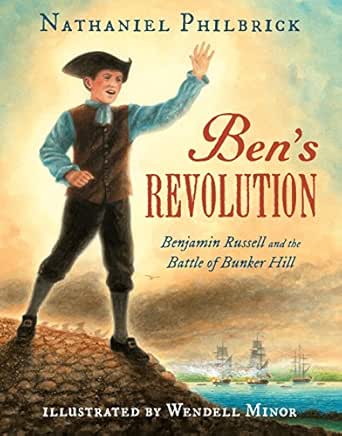
A fictionalized vignette from his Bestselling Book Bunker Hill: A City, A Siege, a Revolution, Philbrick turns his talents to young people. The Ben of the title is famed journalist and politician Ben Russell, who as a boy left school at the start of the Revolutionary War to follow the troops. He found himself cut off from his family in Boston and stayed serving the soldiers as a clerk. Ben witnessed first hand many important moments in the first year of the Continental Army, including the Battle of Bunker Hill. Four months later his father manages to escape the city to rescue him. Since the war was no place for a boy, Father places Ben in an apprenticeship with patriot newspaperman Isiah Thomas, where he learns the business and gets started on his way to his future career. An author's note at the end tells us more about this great man and separates the fact from the fiction. An artist's note directly after explains to the reader the research process involved in creating the beautiful artwork and the overall process of the artist.

Adult author and researcher, Philbrick, takes the child-friend and interesting bits from his best-selling adult book and adapts it for young readers. Even though he lived long ago, kids will identify with Russell, who is a typical rambunctious, curious, and adventurous kid. My favorite part of the account is when a group of boys complain to a British officer that by spreading ashes over the road in front of his house he made the hilly street non-conducive to sledding.  Because kids will relate to Ben, they will be able to live the life of a Revolutionary War clerk during this important time period in American history. Ben is a great role-model for young people in that he was a true patriot, was not afraid to stand up for what he believed to be right, was very bold, and performed a grown-up job even though he was a boy. Philbrick also explains that there are two sides to a war and portrays the enemy as real people, who were formally friends and now find themselves on the opposite side of the issues. A perfect choice for early chapter-book readers, the print is big, the plot is linear, the margins are wide, and the layout is appealing. Minor's colorful illustrations are plentiful and can be seen on every two-page spread, sometimes taking up the whole page with no words included. A boy's eye view of the Revolutionary War and a tribute to a great American.

Tuesday, May 16, 2017

Quicksand Pond

Image result for quicksand pondQuicksand Pond
Janet Taylor Lisle
Atheneum/Simon and Schuster, 2017
240 pages
Grades 4-7
Realistic Fiction

Jessie, along with her father, older sister, and younger brother, escape the summer heat of urban Pittsburgh and move into a ramshackle cottage on Quicksand Pond on Rhode Island's coast, a local where Dad spent a summer as a young man. Her older sister is on a quest to be popular and chooses to spend her days on the beach. Younger brother spends his time at a new friend's pool. Jessie prefers the quiet pond on which the house sits. It is here that she uncovers an ancient raft and meets a new friend. Terri is a local girl with a shady family. The two girls instantly bond and set to work restoring the raft. They spend their days floating around the quiet pond and exploring the natural wildlife. Meanwhile, an old woman is watching them through her window with binoculars. She remembers her days on the pond on that raft and welcomes the girls to the tools in her garage to fix it up. Jessie's family is nervous about her relationship with Terri. Is it true what they say about her family? Her grandfather spent most of his adult life in prison after allegedly murdering the old lady's family and her father is a nasty drunk. When valuable items are stolen from the old lady's garage and it is set on fire, all fingers point to Terri. Jessie finds herself in the crossfire. Did Terri do it? Should Jessie cast a light on Terri to make her look more suspicious and to keep herself out of trouble? And who really did murder the old lady's family? Things aren't always what they seem at first glance and Jessie must find the courage to follow her conscious.

Newbery honor winner, Lisle, pens a novel for young people set in a real place; Quicksand Pond, to be found in Lisle's home state of Rhode Island. Lisle's love for the local and respect for it's animal's and fauna comes through in the story, as does her appreciation for its quiet pleasures, such as enjoying the pond from a raft. Readers will envy Jessie's summer spent with a new friend exploring pond life on a raft with complete freedom, while Dad works on writing a book. The setting and mood are predominate in this reading experience, but Lisle also offers an interesting plot. We see the story through Jessie's eyes as well as those of Henrietta Cutting, the old lady in the window. Henrietta and Terri's pasts are connected and a mystery emerges: whether or not Terri's grandfather is responsible for Henrietta's family's death. While watching the girl's on the raft, Henrietta remembers the truth behind that fateful night, sees that justice is done, and finds some peace. Sensitive readers will enjoy this story that shows that life isn't always black and white. Lisle brings attention to inequality between social classes and the justice system. Other themes include the importance of honesty, loyalty, finding time to enjoy family over constant working, and of course the appreciation of nature and simple pleasures. Jessie must find the courage to stand up for what she believes is right and to remain loyal to her friend, even though the rest of the town is against Terri. Great lessons for kids are hidden among an interesting plot and a fully realized and beautifully peaceful settling. A great summer read for thoughtful kids.