 Confessions of a Murder Suspect
James Patterson and Maxine Paetro
Little Brown 2012
Grades 7-Up
Mystery
Confessions of a Murder Suspect
James Patterson and Maxine Paetro
Little Brown 2012
Grades 7-Up
Mystery
Tandy Angel is awaken in the middle of the night by the police banging on her New York City Dakota apartment door. Her rich and powerful parents have been murdered in their beds inside the apartment while their three children and personal assistant slept. An untrustworthy uncle is left in charge of the family, while the grown-up estranged brother re-enters the the family. The Angel offspring are not like normal children. They have super-human strength and intelligence. While two brothers exhibit incredible strength and athletic abilities, another brother is a musical and artistic protege. Tandy is the cleverest (and least emotional) of them all. It is up to her to find her parent's killers. Unfortunately, the main suspects are her own family members--including herself. Family secrets are slowly revealed, including the truth behind the Angel children's gifts, the real nature of their parents relationship, and Tandy's past, which is buried in her subconscious. By book's end the truth behind Malcolm and Maud Angel's deaths is uncovered, but more family mysteries have cropped up, leading the reader to run for the book's sequel: Confessions: the Private School Murders. Soon to be released in October is the third in the series Confessions: The Paris Mysteries.
It is no accident that James Patterson is the most successful American author alive today. His adult books are snatched up and devoured by devoted fans for their surprising plot twists, fast pace and high action. His books for young people exhibit the same characteristics. Patterson is passionate about getting young people to read. The books he writes for teens and kids (with help from other authors--otherwise there is no way he could churn out so many titles every year!) have excellent story lines and are addicting to read. In Confessions of a Murder Suspect Patterson offers young people what he writes best: a traditional mystery. What isn't traditional in mysteries for teens is the unreliable narrator, who we know is hiding something and in the back of our minds we think may be the killer. A lot of possible suspects are introduced, but not too many to be confusing. The conclusion of the mystery is satisfying, yet not too obvious. The unanswered questions popping up during the investigation naturally lead readers to the sequel while still giving them the satisfaction that the book concluded. Is Tandy a likable character? Not really, but she is very interesting, tough as nails, confident, and rich. Teens of both genders will eat this book up and adults will like it too. I only wish that the cover was a bit more ambiguous. A girl's picture on the cover will put off boys, even if she (or the book) isn't "girlie". Hopefully boys will overlook the cover and give it a try. They won't be disappointed. Patterson knows what readers want. Let's hope his deep well of ideas never runs dry and he can keep putting out entertaining and exciting books that keep teens (and adults) turning pages!
 Skink: No Surrender
Carl Hiaasen
Knopf, 2014 281 pgs
Grades 6-9
Mystery/Adventure
Skink: No Surrender
Carl Hiaasen
Knopf, 2014 281 pgs
Grades 6-9
Mystery/Adventure
Richard's crazy cousin Malley runs off with some older guy she met in a chat room on-line. Her parents and the police are hitting dead ends. Enter Stink; a former veteran/governor turned wild environmentalist vigilante, who looks deceivingly like a homeless person. Richard meets Skink while he is buried in the sand, breathing through a straw, patiently waiting to nab a turtle-egg thief. Skink agrees to team up with Richard to find Malley, clears it with Richard's folks, and the two unlikely heroes hit the road. Adventures and misadventures ensue involving edible road-kill, baby skunk rescues, and litter bugs who need to be taught a lesson. Stink and Richard become separated time and again, yet Skink manages to reappear just when Richard needs him the most. Finally the team tracks Malley down on a stolen house boat in a remote part of Florida. Malley is being held against her will and her captor is nasty, a bit unhinged, and has a gun. Between Skink's fearless strength, Richard and Malley's quick talking and thinking, and dumb luck they manage to escape and the evil kidnapper meets a deserving conclusion.
Hiaasen is known for his quirky characters, Florida setting, and environmental concerns. Skink: No Surrender falls right into this expectation. Skink is a reoccurring character in many of Hiaasen's adult novels (which I've admittingly never read, although I've read all of his novels for young people). He is an amazing character and certainly worthy of his own book. Skink threw fame and fortune away to follow ideals of importance to him. He is dirty, smelly, puts weird things into the socket of his missing eye, runs around in a bathing cap and care only about doing what he believes is right and ethical. Richard, still mourning the surprise loss of his beloved father, finds courage and confidence and, eventually, healing. Mallie discovers some much needed humility, accountability, and appreciation of her parents. The plot never flags and Hiaasen loves to throw some curve balls at us to keep us awake. The mystery involves finding Mallie and identifying the kidnapper. There is action galore, including a run-in with a gator (very Hiaasen-esque). Boys especially will love this book, but girls will like it too. The level of violence and suggestiveness of what may have happened to Mallie while being held captive make this this book more appropriate for a slighter older audience than Hiaasen's other books for young people. I hope we see Skink again. The world needs more real-life superheroes!
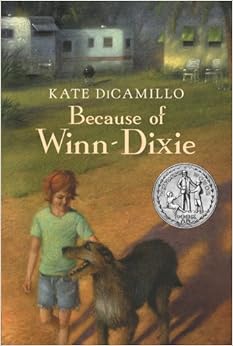 Because of Winn Dixie
Kate DiCamillo
Candlewick 2000 182 pgs
Grades 4-6
Realistic Fiction
Because of Winn Dixie
Kate DiCamillo
Candlewick 2000 182 pgs
Grades 4-6
Realistic Fiction
Opal is struggling with settling in to her new Florida town after a move with her preacher father. After an unfortunate scene at the Winn Dixie, Opal and a scraggly looking dog find each other and she fittingly names him Winn Dixie after the supermarket. Winn Dixie provides Opal with companionship and a sounding board. He gives her courage to meet new friends and to finally ask her father to tell her ten things about her estranged mother. The friends Opal meets are a rag-tag bunch; the elderly town librarian, a five-year-old little girl, the former prison inmate pet store manager, a pinch-faced snotty girl of her own age, the town "witch" who lives alone in the woods, and two pesky boys with unfortunate haircuts and smart mouths. As Opal makes new connections with the folks around her, she realizes that everyone is carrying burdens. The book climaxes with a big party, gathering all of Opal's new friends and her father together. It is then that people begin to let their guards down and feel the healing power of love and friendship, including Opal herself.
Ten Things about Because of Winn Dixie:
1. It has quirky, flawed, well-developed, and wonderful characters.
2. It contains a terrifically lovable dog and proves the healing power of animals.
3. It celebrates the magic of music and contains an unforgettable scene where the manager has all the animals in the pet shop dancing to his guitar.
4. It demonstrates to kids not judge people by the first impression. Get to know them and see what is beneath the mask.
5. It is a wonderful piece of Americana, solidly set in the south of a time that could be now or fifty years ago.
6. It values the power of storytelling. features a passionate and kind librarian, and emphasizes the importance of books.
7. It is a tribute to the importance of community, multi-generational relationship, and all of us working together to overcome the hurt in our lives. We can't do it alone.
8. It contains magical candy and a party with twinkle lights.
9. It is an excellent read-aloud.
10. It is a superbly written children's book, which was awarded a Newbery Honor in 2001 (but should have won the medal).
 The City of Ember
Jeanne DuPrau
Random 2003 270 pgs
Grades 4-7
Science Fiction
The City of Ember
Jeanne DuPrau
Random 2003 270 pgs
Grades 4-7
Science Fiction
Lina and Doon have lived in the City of Ember their whole lives. Lately things have been going downhill. The once abundant storerooms are emptying and store shelves no longer contain many choices or products. Worse of all, the electric lights that the city depends on to see have been on the fritz and the city is experiencing temporary black-outs. As Lina and Doon graduate from school at age twelve and start their adult occupations they begin to question their way of life and wonder if there is life outside of Ember. Lina finds a mysterious box containing a letter that looks important. Unfortunately, Lina's baby sister gets to the note first and huge chunks are missing. By deciphering what is left in the note, Lina and Doom are able to ascertain that it is instructions for leaving the city. Meanwhile, they discover that the mayor is selfishly hoarding what is left of Ember's precious commodities and they attempt to expose him. The Mayor calls for Lina and Doon's arrest, so the two adventurers must grab what they can, along with Lina's baby sister, and try to escape the city.
Although not a new book, City of Ember is a great choice to give to kids looking for currently in demand dystopian fiction, but not quite ready for Hunger Game or Divergent. The underground world is kind of creepy and cool. DuPrau let us in on the secret early that Ember is underground and it gives us a pleased leg-up when Doon and Lina finally figure it out by the end. Lina and Doon are both smart, resourceful and brave. They will inspire young people to question the world around them and to venture out of their comfort zone. The adults are for the most part ineffectual and flawed, leaving the saving of the civilization to a couple of twelve-year-olds with minimal supervision. The plot moves quickly, the setting is well developed and atmospheric, and the story takes many twist and turns. The mysterious instructions with missing words adds a mystery element to the story, further creating interest. Having both a male and female main character allows for the book to be accessible to both sexes. A great sci-fi choice for those who don't like sci-fi, The City of Ember is a well written child-friendly adventurous story to be devoured by all. Most of all, it makes us appreciate sunshine and electricity and think ahead to the future of our planet.
 Beauty Queens
Libba Bray
Scholastic 2011 396 pgs
Grades 9-Up
Adventure
Beauty Queens
Libba Bray
Scholastic 2011 396 pgs
Grades 9-Up
Adventure
A terrible plane crash lands a group of pageant contestants for the "Miss Teen Dream" beauty contest on their own on a deserted island. At first dazed and confused, they eventually ban together and work cooperatively on surviving. Gradually we get to know the girls and, as the book progresses, their masks begin to slip and we see their true selves. Friendships form and the competitive spirit of the beauty pageant fades as survival becomes a more important goal. Unbeknownst to the girls, they are not alone on the island. "The Corporation" has a secret lair where they are working on an arms deal with a crazy Elvis-impersonating dictator. Just when the girls are hitting their stride, a ship of cute, British, reality TV pirates lands on the island to stir things up. After several love connections are made, the fake pirates abandon the girls, leaving it up to them to thwart the evil pans of the cooperation and escape from the island. Written with tongue-in-cheek humor and interspersed with commercials, pageant bios of the girls, and entertaining footnotes, Beauty Queens is a satire taking on beauty pageants, big business, the media, reality television and social inequality. It is a celebration of womanhood and what really makes us beautiful.
Beauty Queens is a "concept book"; a bunch of beauty queens stranded on an island where they discover explosive hair removal and overthrow an evil dictator. With this concept the book seems irresistible. In reality I found it to be a bit "over the top". Maybe I was expecting more hard hitting adventure and less satire. Much of the book seemed to be thinly veiled messages warning of the corruption of today's society. That said, Beauty Queen is more teen-friendly than Bray's 2010 Prince winning Going Bovine and, honestly a lot of fun. It reads quickly and the plot never lags. The superficial beauty queens are a mix of race, gender, and sexuality, which was nice to see. The girls all experience character growth throughout the book, are multidimensional, and become likable and real (even the really horrible one from Texas). The beauty queens are resourceful, brave and celebrate "girl power". A wide range of teens will be attracted to the concept and cover and, once diving in, will go along for the ride. Seemingly shallow, if stranded on a deserted island, these are the peeps you want to be stuck with.
 How to Eat Fried Worms
Thomas Rockwell
Dell, 1973 127 pgs
Grades 3-5
Realistic Fiction/Humor
How to Eat Fried Worms
Thomas Rockwell
Dell, 1973 127 pgs
Grades 3-5
Realistic Fiction/Humor
Billy claims that he'll eat anything. On a slow summer day Billy makes a $50 bet with his friend Alan that he can eat a worm a day for fifteen straight days. The terms are that Alan gets to pick the worm and that Billy must eat it whole, although he is allowed to cook it and flavor it however he likes. Seconds are chosen and the bet is on! After Billy overcomes the initial disgust and fear of eating a slimy worm, he begins to enjoy himself. He dine's on worms boiled, fried, and fricasseed with every kind of condiment imaginable. That's when the competition gets ugly. Alan and his second concoct devious plans to try to trick Billy out of eating his worm, including trying to get Billy's mother to stop him from eating the worms. As the bet nears to a close the boys get desperate and their once close friendship evolves into a battle royal. Does Billy manage to eat all fifteen worms and win the bet? Read the book and find out!
Every once in a while I like to re-read a favorite book from my childhood to see if it stood the test of time and is still relevant to today's youth. How to Eat Fried Worms is indeed a step back into a past where children run wild all summer, coming home when it is time for dinner. The parents are have stereotypical roles and their are no girls in sight in this all-boy world (a female character is added to the 2006 movie). Certain terms the boys use (they love to call each "finks") also dates the book, as does the complete absence of electronics. Although How to Eat Fried Worms is a step into the past it is still an enjoyable read. The title itself is a winner begging kids to pick it up. The chapters are short, the book reads quickly, and humor abounds. Rockwell doesn't bog the book down with heavy messages and subplots. It is a straight forward business with a satisfying ending. Rockwell knows the world of boys and what makes them tick. Worms is solidly a "boy book", but, and I am proof from my own childhood, will also be enjoyed by girls. Put it in the hands of reluctant summer readers. This forty-year-old book still does the job, offering slightly gross fun and hi-jinks.
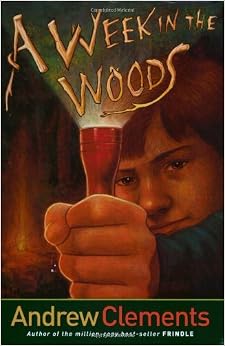 A Week in the Woods
Andrew Clements
Simon and Schuster, 2002 190 pgs
Grades 3-6
Realistic/Adventure
A Week in the Woods
Andrew Clements
Simon and Schuster, 2002 190 pgs
Grades 3-6
Realistic/Adventure
Fifth-grader Mark must move midyear from his beloved West Chester home to "the wilds" of New Hampshire. He resists the move, made worse by the increasing absence of his parents. Left at home with a cook and a handy-man, Mark discovers the beauty in the country around him and begins to explore the woods with snowshoes. Knowing he is switching to a private school in the fall, Mark makes zero effort to connect with teachers and fellow students. Meanwhile, we meet Mr. Maxwell, a science teacher who puts together a yearly spring "week in the woods" event. He tries to be friendly to Mark, but after the boy is rude to him he gives up, thinking Mark a spoiled rich kid. By the time the trip arrives Mark has had a change of heart. He has made some new friends and has cultivated his love of the great outdoors, greatly anticipating the week-long camping trip. The trip is ruined, however, when Mr. Maxwell discovers a camping tool/knife and Mark gets mistakenly blamed for breaking the rules and bringing along a weapon. Mark takes his gear and disappears into the woods, where Mr. Maxwell, discovering his mistake, must find him to make things right.
Andrew Clements is the master of "the school story". A Week in the Woods is a bit of a departure in that much of the action takes place at Mark's home or on the field trip. Still, the main conflict is Mark adjusting to the new school and coming to an understanding with Mr. Maxwell. The book is presented in two points of view (Mark & Mr. Maxwell's) allowing the reader to see both sides of the story. Reading Mr. Maxwell's point of view helps the reader to understand the humanity behind their teachers, while Mark's story sheds light on what can really be going on in the heads of kids who are stand-offish, as well as offering the reader a young character to relate to. Its wonderful to see Mark slowly adjust to a new environment, discover a new hobby, and start to heal after the hurt of the forced move. The real conflict behind the story is Mark's estranged parents and their lack of attention on the boy's life. By the book's end we see the parents making more of an effort to connect to Mark and to spend more time with him, leaving the reader with hope for this relationship. A Week in the Woods is a great story that will be enjoyed by many levels of readers. Appealing to boys more than girls, it can be appreciated by both. Clements really knows how kids think and what is important to them and his books are always realistic and relate-able with a moral message. I'm a big fan of Andrew Clements, my favorites being Frindle and Extra Credit, and feel that A Week in the Woods stands up as one of his best.
